live with the world

BEST TORRENTING TOOL

 We all worry about downloading torrents whether it's safe or not. Not only that we also worry about our internet speed to download that particular torrent. And there are many restrictions in downloading torrents depending on the location.

The solution to all these problems is to download torrents on any cloud machine which is very expensive. But there is a service to download unlimited torrents irrespective of the file size. The service is called "seedr". It's very simple and easy to use, I really love the streaming option once the video or audio etc is downloaded to your seedr account. This option helps to check the quality of the file before downloading it. Not only that there is also the support of chrome cast to streaming. You don't even need to download it to your computer or mobile, you can stream it on your PC or mobile or cast to a TV using the cast option.

To download any torrent use the "magnet link" or "torrent file download link" of that particular torrent and past it in the URL text box in the account depending on the available seeds, your file will be downloaded. Within a few seconds, your torrent file is ready to stream or download. Visit https://www.seedr.cc/ to know more about seedr.

Are we stupid

Consider your job is to maintain a car fleet for your company. You manage two models, an SUV that gets 10 miles to the gallon and a sedan that gets 20. The fleet has equal numbers of each, and all the cars travel 10,000 miles a year. Your company have enough capital to replace one model with more fuel-efficient vehicles to lower operational costs and help meet sustainability goals.

Which upgrade is better?

A. Replacing the 10 MPG vehicles with 20 MPG vehicles

B. Replacing the 20 MPG vehicles with 50 MPG vehicles

Option B seems more impressive—an increase of 30 MPG is a lot larger than a 10 MPG one. And the percentage increase is greater, too. Right? Let’s compare. 

GALLONS USED PER 10,000 MILES
CURRENTAFTER UPGRADESAVINGS
A.1,000 (@10 MPG)500 (@20 MPG)500
B.500 (@20 MPG)200 (@50 MPG)300

See B is not the better deal. What is this?! Is this a joke? Now let's take a deep dive into this concept. 

Decades of research in cognitive psychology show that the human mind struggles to understand nonlinear relationships. Our brain wants to make simple straight lines. In many situations, that kind of thinking serves us well: If you can store 50 books on a shelf, you can store 100 books if you add another shelf, and 150 books if you add yet another. Similarly, if the price of coffee is $2, you can buy five coffees for $10, 10 coffees with $20, and 15 coffees with $30.

But in real life, this is not the case. Our brain turns everything around us into its own convenient way of understanding it. that's why we all choose option B instead of A. When we make decisions without analysing the inputs and outcomes this happens.

So it is up to you when making such a kind of choice, think about the outcome. Start to analyse the situation in a non-linear way by taking all the factors into account. Try to improve your non-leniar thinking by rediscovering the world around you.


Smell of rain—What is the reason for it—Does rain really smells ?

We all remember the smell of the first raindrop that kisses the hot, dry earth. As my childhood is spent on a farm with farmers thinking of many natural processes happening in nature. But today I found one interesting article about the smell of rain, let me share with you why it does so.

Of course, rain itself has no scent. But moments before a rain event, an “earthy” smell known as petrichor does permeate the air. People call it musky, fresh—generally pleasant.

This smell actually comes from the moistening of the ground. Australian scientists first documented the process of petrichor formation in 1964 and scientists from the Massachusetts Institute of Technology further studied the mechanics of the process in the 2010s. 


Petrichor is a combination of fragrant chemical compounds. Some are from oils made by plants. The main contributor to petrichor is actinobacteria. These tiny microorganisms can be found in rural and urban areas as well as in marine environments. They decompose dead or decaying organic matter into simple chemical compounds which can then become nutrients for developing plants and other organisms.

A byproduct of their activity is an organic compound called geosmin which contributes to the petrichor scent. Geosmin is a type of alcohol, like rubbing alcohol. Alcohol molecules tend to have a strong scent, but the complex chemical structure of geosmin makes it especially noticeable to people even at extremely low levels. Our noses can detect just a few parts of geosmin per trillion of air molecules.

When raindrops fall on the ground, especially porous surfaces such as loose soil or rough concrete, they will splatter and eject tiny particles called aerosols. The geosmin and other petrichor compounds that may be present on the ground or dissolved within the raindrop are released in aerosol form and carried by the wind to surrounding areas. If the rainfall is heavy enough, the petrichor scent can travel rapidly downwind and alert people that rain is soon on the way.

The scent eventually goes away after the storm has passed and the ground begins to dry. This leaves the actinobacteria lying in wait—ready to help us know when it might rain again.

3D printers are now ready to print circuit boards

Jesus Zozaya is quick to mention a major problem when producing circuit boards: time. “You need one that works for you and you can be at the mercy of when it will be created and when it will arrive,” he says. “That doesn’t help when you need to move forward.”

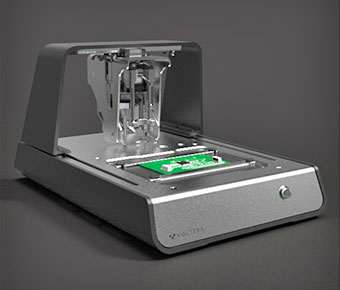
As a co-founder of Voltera, he’s been a part of a journey to put the customer further in control while maneuvering through the realities of business. “It started for us [his team] as students from the University of Waterloo in 2013 for a fourth year design project,” he says. “3D printing was already quite popular. My partner brought up that there are a lot of 3D printers out there that are using plastic to create mechanical components so why not use ink of some sort to create electrical components?”

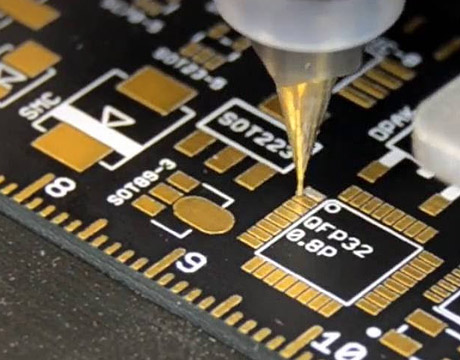
This was the project that was chosen and many different technologies were tried, starting with Inkjet. “We finally settled on a process similar to an extrusion-based technology where we have conductive ink in a cartridge, basically just regular syringes, and it gets extruded by applying mechanical pressure through a very small nozzle,” he explains. “We put a lot of effort into trying to find the right type of inks and chemistry to allow us to create very high resolution circuitry while still having excellent electrical property and the ability to solder. There are many inks out there but not all can solder and that can be a big problem.”

They graduated, received free space in an incubator at the University at Waterloo and, from that point on, started a company, he says. “We eventually went into the R&D phase and then got accepted into an accelerator which meant 3 or 4 months in China. And we took all the team members we had at the time,” he says. “It was a very rewarding process where we learned about injection, molding, extrusion, and more. By the time the accelerator was finished, we had a functional prototype that worked and looked good.”

Future Improvements

One of the potential improvements for the future, he says, would be in how many layers can be printed. “The cost of compact circuit boards you find in very tight spaces is four layers or more,” he says. “We’re also playing around with having additional components. Right now the printer doesn’t have a drill so we’re thinking of having a drill module or a pick-and-place module.”

“It’s been a rollercoaster from college,” he says. “There have been moments that were tough along the way but it comes down to how stubborn you’re willing to be. You need to be aware of what you don’t know and have hungry minds to adapt to circumstances. We’ve learned a lot.”

Analysis finds autonomous trucks that drive in packs could save time and fuel

As driverless cars merge into our transportation system in the coming years, some researchers believe autonomous vehicles may save fuel by trailing each other in large platoons. Like birds and fighter jets flying in formation, or bikers and race car drivers drafting in packs, vehicles experience less aerodynamic drag when they drive close together.

But assembling a vehicle platoon to deliver packages between distribution centers, or to transport passengers between stations, requires time. The first vehicle to arrive at a station must wait for others to show up before they can all leave as a platoon, creating inevitable delays.

Now MIT engineers have studied a simple vehicle-platooning scenario and determined the best ways to deploy vehicles in order to save fuel and minimize delays. Their analysis, presented this week at the International Workshop on the Algorithmic Foundations of Robotics, shows that relatively simple, straightforward schedules may be the optimal approach for saving fuel and minimizing delays for autonomous vehicle fleets. The findings may also apply to conventional long-distance trucking and even ride-sharing services.

"Ride-sharing and truck platooning, and even flocking birds and formation flight, are similar problems from a systems point of view," says Sertac Karaman, the Class of 1948 Career Development Associate Professor of Aeronautics and Astronautics
at MIT. "People who study these systems only look at efficiency metrics like delay and throughput. We look at those same metrics, versus sustainability such as cost, energy, and environmental impact. This line of research might really turn transportation on its head."
Pushing through drag
Karaman says that for truck-driving—particularly over long distances—most of a truck's fuel is spent on trying to overcome aerodynamic drag, that is, to push the truck through the surrounding air. Scientists have previously calculated that if several trucks were to drive just a few meters apart, one behind the other, those in the middle should experience less drag, saving fuel by as much as 20 percent, while the last truck should save 15 percent—slightly less, due to air currents that drag behind.

If more vehicles are added to a platoon, more energy can collectively be saved. But there is a cost in terms of the time it takes to assemble a platoon.
Karaman and his colleagues developed a mathematical model to study the effects of different scheduling policies on fuel consumption and delays. They modeled a simple scenario in which multiple trucks travel between two stations, arriving at each station at random times. The model includes two main components: a formula to represent vehicle arrival times, and another to predict the energy consumption of a vehicle platoon.
The group looked at how arrival times and energy consumption changed under two general scheduling policies: a time-table policy, in which vehicles assemble and leave as a platoon at set times; and a feedback policy, in which vehicles assemble and leave as a platoon only when a certain number of vehicles are present—a policy that Karaman first experienced in Turkey.
"I grew up in Turkey, where there are two types of public transportation buses: normal buses that go out at certain time units, and another set where the driver will sit there until the bus is full, and then will go," Karaman says.
When to stay, when to go
In their modeling of vehicle platooning, the researchers analyzed many different scenarios under the two main scheduling policies. For example, to evaluate the effects of time-table scheduling, they modeled scenarios in which platoons were sent out at regular intervals—for instance, every five minutes—versus over more staggered intervals, such as every three and seven minutes. Under the feedback policy, they compared scenarios in which platoons were deployed once a certain number of trucks reached a station, versus sending three trucks out one time, then five trucks out the next time.
Ultimately, the team found the simplest policies incurred the least delays while saving the most fuel. That is, time tables set to deploy platoons at regular intervals were more sustainable and efficient than those that deployed at more staggered times. Similarly, feedback scenarios that waited for the same number of trucks before deploying every time were more optimal than those that varied the number of trucks in a platoon.
Overall, feedback policies were just slightly more sustainable than time-table policies, saving only 5 percent more fuel.
"You'd think a more complicated scheme would save more energy and time," Karaman says. "But we show in a formal proof that in the long run, it's the simpler policies that help you."
Ahead of the game
Karaman is currently working with trucking companies in Brazil that are interested in using the group's model to determine how to deploy truck platoons to save fuel. He hopes to use data from these companies on when trucks enter highways to compute delay and energy tradeoffs with his mathematical model.
Eventually, he says, the model may suggest that trucks follow each other at very close range, within 3 to 4 meters, which is difficult for a driver to maintain. Ultimately, Karaman says, truck platoons may require autonomous driving systems to kick in during long stretches of driving, to keep the platoon close enough together to save the most fuel.
"There are already experimental trials testing autonomous  [in Europe]," Karaman says. "I imagine truck platooning is something we might see early in the [autonomous transportation] game."
The researchers are also applying their simulations to autonomous ride-sharing services. Karaman envisions a system of driverless shuttles that transport passengers between stations, at rates and times that depend on the overall system's energy capacity and schedule requirements. The team's simulations could determine, for instance, the optimal number of passengers per shuttle in order to save  or prevent gridlock.
"We believe that ultimately this thinking will allow us to build new transportation systems in which the cost of transportation will be reduced substantially," Karaman says.
More information: Optimal Policies for Platooning and Ride Sharing in Autonomy-Enabled Transportation.  wafr2016.berkeley.edu/papers/WAFR_2016_paper_110.pdf 

Increase speed of your windows system

Increase your Windows speed. I will tell you easy methods and a trick to speed up windows 8. You can rapidly increase the speed of your operating system. These methods will cool down your system and increase the performance of Windows 8.
Windows XP is no more. Most of you are using Windows 8, right? There are many reasons for using this operating system. It’s both beautiful and fast. Yet, your computer will slow down over time. It gets worse if you use it daily. It can be quite annoying sometimes. No worries, you can speed up windows 8 performance up by 200% using these 3 simple methods. All of you can do it. There’s no need to call in an expert.

Don’t Use too Many Startup Apps – Speed Up Windows 8

The key is to reduce the number of start-up apps. They are one the major reasons why the computer gets slower. What are start-up applications? The name suggests that they are apps which will be active when you boot your PC. Needless to say, they become the burden for your operating system. The best way to increase your PC performance is to disable some useless start-up applications. Follow these steps:
  • Right-click on the taskbar to open the Task Manager. Remember, you need to enable it beforehand.
  • Once it opens up, pick More Details option to see the list of all start-up apps.
  • When you see the stretched window, click the Startup tab.
  • This way, you can see which apps are taking most of the PC’s memory. You can freely disable them by pressing the disable button.

Disable Background Search Indexing – Speed Up Windows 8

This is a good method to increase the performance of your computer. The fact is that the Windows 8 search utility is quite smooth. It helps to search files or items on your computer. That means it keeps indexing the whole data in the background. Even though it’s useful, it takes too much amount of your computer’s performance. As the result, your computer gets slower over time. Turning off background search indexing will make the PC faster. You only need to follow the instruction below:
  • Open the Run command box on the desktop. You can do it by pressing [Win key + R].
  • Next, type and enter ‘services.msc’.
  • As the result, you can see the list of services running on your operating system. Find Windows Search in such list and double-click on it.
  • You will see a pop-up window with numerous Windows Search Properties. There’s a disable button below the general tab. You need to press it.
  • Disable the running search indexing process by pressing the ‘Stop’ button. The last thing to do is to press the ‘Apply’ button.
  • To make it faster, you need to reboot your PC.

Turn Off Animations – Speed Up Windows 8

Another method is to disable time-wasting animations. Both Windows 7 and Windows 8 display animations when working on applications. They are indeed good for your eyes, but they decrease your computer performance. You need to turn them off to eliminate the delay. Press the Window key and type System Performance Properties. Press enter. Uncheck the ‘animate windows’. You can also uncheck other types of animations. This way, you can fasten your operating system as it doesn’t need to work hard on animations. You need to decide whether to get an amusing display or a good performance. Unless you don’t have a superb computer, you can’t get both of them.

Transparent, flexible supercapacitors pave the way for a multitude of applications

The standard appearance of today's electronic devices as solid, black objects could one day change completely as researchers make electronic components that are transparent and flexible. Working toward this goal, researchers in a new study have developed transparent, flexible supercapacitors made of carbon nanotube films. The high-performance devices could one day be used to store energy for everything from wearable electronics to photovoltaics.
The researchers, Kanninen et al., from institutions in Finland and Russia, have published a paper on the new supercapacitors in a recent issue of Nanotechnology.
In general, supercapacitors can store several times more charge in a given volume or mass than traditional capacitors, have faster charge and discharge rates, and are very stable. Over the past few years, researchers have begun working on making supercapacitors that are transparent and flexible due to their potential use in a wide variety of applications.
"Potential applications can be roughly divided into two categories: high-aesthetic-value products, such as activity bands and smart clothes, and inherently transparent end-uses, such as displays and windows," coauthor Tanja Kallio, an associate professor at Aalto University who is currently a visiting professor at the Skolkovo Institute of Science and Technology, told Phys.org. "The latter include, for example, such future applications as smart windows for automobiles and aerospace vehicles, self-powered rolled-up displays, self-powered wearable optoelectronics, and electronic skin."
The type of supercapacitor developed here called an electrochemical double-layer capacitor, is based on high-surface-area carbon. One prime candidate for this material is single-walled carbon nanotubes due to their combination of many appealing properties, including a large surface area, high strength, high elasticity, and the ability to withstand extremely high currents, which is essential for fast charging and discharging.
The problem so far, however, has been that the carbon nanotubes must be prepared as thin films in order to be used as electrodes in supercapacitors. Current techniques for preparing single-walled carbon nanotube thin films have drawbacks, often resulting in defected nanotubes, limited conductivity, and other performance limitations.
In the new study, the researchers demonstrated a new method to fabricate thin films made of single-walled carbon nanotubes using a one-step aerosol synthesis method. When incorporated into a supercapacitor, the thin films exhibit the highest transparency to date (92%), the highest mass-specific capacitance (178 F/g), and one of the highest area specific capacitances (552 µF/cm2) compared to other carbon-based, flexible, transparent supercapacitors. The films also have a high stability, as demonstrated by the fact that their capacitance does not degrade after 10,000 charging cycles.
With these advantages, the new device illustrates the continued improvement in the development of transparent, flexible supercapacitors. In the future, the researchers plan to further improve the energy density, flexibility, and durability, and also make the supercapacitors stretchable.
"One more important characteristic to be realized and urgently expected in future electronics is the stretchability of the conductive materials and assembled electronic components," said co-author Albert Nasibulin, a professor at the Skolkovo Institute of Science and Technology and an adjunct professor at Aalto University. "Together with Tanja, we are currently working on a new type of stretchable and transparent single-walled carbon nanotube supercapacitor. We are confident that one can create prototypes based on carbon nanotubes that might withstand 100% elongation with no performance degradation."
More information: Kanninen et al. "Transparent and flexible high-performance supercapacitors based on single-walled carbon nanotube films." Nanotechnology. DOI: 10.1088/0957-4484/27/23/235403


Seawater usable for production and consumption of hydrogen peroxide as a solar fuel

Scientists have used sunlight to turn seawater (H2O) into hydrogen peroxide (H2O2), which can then be used in fuel cells to generate electricity. It is the first photocatalytic method of H2O2 production that achieves a high enough efficiency so that the H2O2 can be used in a fuel cell.
The researchers, led by Shunichi Fukuzumi at Osaka University, have published a paper on the new method of the photocatalytic production of hydrogen peroxide in a recent issue of Nature Communications.
"The most earth-abundant resource, seawater, is utilized to produce a solar fuel that is H2O2," Fukuzumi told Phys.org.
The biggest advantage of using liquid H2O2 instead of gaseous hydrogen (H2), as most fuel cells today use, is that the liquid form is much easier to store at high densities. Typically, the H2 gas must be either highly compressed or in certain cases, cooled to its liquid state at cryogenic temperatures. In contrast, liquid H2O2 can be stored and transported at high densities much more easily and safely.
The problem is that that, until now, there has been no efficient photocatalytic method of producing liquid H2O2. (There are ways to produce H2O2 that doesn't use sunlight, but they require so much energy that they are not practical for use in a method whose goal is to produce energy.)
In the new study, the researchers developed a new photoelectrochemical cell, which is basically a solar cell that produces H2O2. When sunlight illuminates the photocatalyst, the photocatalyst absorbs photons and uses the energy to initiate chemical reactions (seawater oxidation and the reduction of O2) in a way that ultimately produces H2O2.
After illuminating the cell for 24 hours, the concentration of H2O2 in the seawater reached about 48 mM, which greatly exceeds previously reported values of about 2 mM in pure water. Investigating the reason for this big difference, the researchers found that the negatively charged chlorine in seawater is mainly responsible for enhancing the photocatalytic activity and yielding the higher concentration.
Overall, the system has a total solar-to-electricity efficiency of 0.28%. (The photocatalytic production of H2Ofrom seawater has an efficiency of 0.55%, and the fuel cell has an efficiency of 50%.)
Although the total efficiency compares favorably to that of some other solar-to-electricity sources, such as switchgrass (0.2%), it is still much lower than the efficiency of conventional solar cells. The researchers expect that the efficiency can be improved in the future by using better materials in the photoelectrochemical cell, and they also plan to find methods to reduce the cost of production.
"In the future, we plan to work on developing a method for the low-cost, large-scale production of H2O2 from seawater," Fukuzumi said. "This may replace the current high-cost production of H2O2 from H2 (from mainly natural gas) and O2."
More information: Kentaro Mase et al. "Seawater usable for production and consumption of hydrogen peroxide as a solar fuel." Nature Communications. DOI: 10.1038/ncomms11470 


New technique could make large, flexible solar panels more feasible

A new, high-pressure technique may allow the production of huge sheets of thin-film silicon semiconductors at low temperatures in simple reactors at a fraction of the size and cost of current technology. A paper describing the research by scientists at Penn State University appears May 13, 2016 in the journal Advanced Materials.

"We have developed a new, high-pressure, plasma-free approach to creating large-area, thin-film ," said John Badding, professor of chemistry, physics, and materials science and engineering at Penn State and the leader of the research team. "By putting the process under high pressure, our new technique could make it less expensive and easier to create the large, flexible semiconductors that are used in flat-panel monitors and solar cells and are the second most commercially important semiconductors."
Thin-film  semiconductors typically are made by the process of , in which silane—a  composed of silicon and hydrogen—undergoes a chemical reaction to deposit the silicon and hydrogen atoms in a thin layer to coat a surface. To create a functioning semiconductor, the chemical reaction that deposits the silicon onto the surface must happen at a low enough temperature so that the  are incorporated into the coating rather than being driven off like steam from boiling water. With current technology, this low temperature is achieved by creating plasma—a state of matter similar to a gas made up of ions and free electrons—in a large volume of gas at low pressure. Massive and expensive reactors so large that they are difficult to ship by air are needed to generate the plasma and to accommodate the large volume of gas required.
"With our new high-pressure chemistry technique, we can create low-temperature reactions in much smaller spaces and with a much smaller volume of gas," said Badding. "The reduced space necessary allows us, for the first time, to create semiconductors on multiple, stacked surfaces simultaneously, rather than on just a single surface. To maximize the surface area, rolled-up flexible surfaces can be used in a very simple and far more compact reactor. The area of the resulting rolled-up semiconducting material could, upon further development, approach or even exceed a square kilometer."


More information: Rongrui He et al. High Pressure Chemical Vapor Deposition of Hydrogenated Amorphous Silicon Films and Solar Cells, Advanced Materials (2016). DOI: 10.1002/adma.201600415 

Hundredfold optical fiber capacity increase sends thousands of HDTV videos per second

Nippon Telegraph and Telephone Corporation and collaborating labs have demonstrated the world's highest density optical fiber using a deployable optical fiber diameter of less than 250 µm. This optical fiber contains 19 optical paths (cores) that can support six kinds of optical signals (modes), and it provides 114 (= 6 modes × 19 cores) spatially multiplexed communication paths (channels) in one optical fiber.

A glass diameter of less than 250 µm makes it possible to ensure that optical fiber has sufficient reliability (i.e. bendable fiber that does not break). Accommodating 114 channels in one optical fiber enables us to transfer thousands of HDTV videos per second. The achievement indicates the reality of ultra-large capacity optical fiber that can handle a Peta- to Exa-bit.
We will continue to contribute to the realization of a future ultra large transmission capacity optical link.
This remarkable achievement was reported in March as a postdeadline paper at the Optical Fiber Communication Conference and Exposition (OFC 2016), the largest conference on optical communication in North America, which was held in Anaheim, California, USA.
This work was partially based on work commissioned by the National Institute of Information and Communications Technology (NICT).
Recent figures released by the Ministry of Internal Affairs and Communications indicate that the data transmission capacity in Japan exceeded 2.5 Tera-bits per second (Tera = 1012) in November 2013. This trend will require a data capacity of 100 Tera-bits per second by the late 2020s. It is also expected that the capacity crunch facing existing optical fiber, which has one optical path (core) supporting one kind of optical signal (mode), may be reached at the same time. This background means we must install additional optical fibers in the 2020s. However, the maximum number of optical fibers that can be stored in one is limited. We will also need to construct additional optical wiring infrastructure underground and in buildings, if there is insufficient space in the existing infrastructure.
Hundredfold optical fiber capacity increase sends thousands of HDTV videos per second
Figure 1 Design guideline for world’s highest core density optical fiber
To address these concerns, worldwide research has been under way on new optical fiber that uses space multiplexing technology. For example, multi-core optical fiber accommodates many cores in one optical fiber, and multi-mode optical fiber supports many modes in one core. However, it is difficult to obtain more than 50 communication paths (channels) using one core or mode multiplexing because of the limit to the glass diameter or the controllability of the refractive index profile. With this as the background, NTT, Fujikura and Hokkaido University (Laboratory of Information Communication Photonics) combined their expertise to realize an optical fiber with more than 100 channels while maintaining a deployable glass diameter by considering the best mix of core- and mode-multiplexing.
Details of Achievements
1.Design Guideline of Optical Fiber
NTT has investigated and experimentally confirmed that an optical fiber with a glass diameter of less than 250 µm can be used for over 20 years if an allowable bending radius of 15 - 30 mm is assumed considering actual deployment conditions in the terrestrial optical network. To realize an optical fiber with more than 100 channels, NTT and Hokkaido University numerically derived the optimum refractive index profile for guiding 3 or 6 kinds of optical signal (mode) in one core, and considered various core arrangements that can sufficiently suppress optical signal interference between neighboring cores. As a result, we clarified that a world record 114 channels can be spatially multiplexed when using a glass diameter of less than 250 µm by arranging hexagonally 19 cores that can support 6 modes (114 channels = 6 modes × 19 cores). This design resulted in a core density more than 60 times that in conventional optical fiber, which has one core and supports one mode.
Hundredfold optical fiber capacity increase sends thousands of HDTV videos per second
Figure 2 Optical property of fabricated optical fiber
2.Fabrication and Evaluation
Using the above design guideline as a basis, Fujikura fabricated an 8.75 km long optical fiber, and NTT evaluated its optical property. The optical attenuation at 1550 nm is less than 0.24 dB/km for all 114 channels, and to the best of our knowledge this is the lowest reported value for multi-core fiber using a 6-mode core. The fabricated optical fiber achieved superior uniformity where the variation in optical attenuation between channels was less than 0.03 dB/km. Moreover, we realized a transmission velocity difference between modes of less than 0.33 ns/km in the fabricated optical fiber, and this is one of the key parameters as regards optical transmission using multiple modes. This is also the lowest reported value for multi-core fiber using a 6-mode core, and reveals that the refractive index profiles of 19 cores were precisely controlled during optical fiber fabrication.
3.Applicability to large capacity transmission
To prove the applicability of the fabricated optical fiber to ultra-large capacity transmission, NTT evaluated the transmission quality using the latest QAM digital coherent transmission technology and an optical-fiber-type Fan-In/Fan-Out device. The Fan-In/Fan-Out device enabled 114 individual multiplexed/de-multiplexed optical signals to be launched into the fabricated optical fiber. We confirmed that we obtained a satisfactory transmission quality with a Q-value exceeding 5.7 dB, which corresponds to the lower transmission limit, for all 114 channels.
Hundredfold optical fiber capacity increase sends thousands of HDTV videos per second
Figure 3 QAM signal transmission performance
The present achievements indicate that an optical fiber using space multiplexing technology can be deployed while maintaining sufficient reliability for a few tens of years. A 100 times larger capacity can be realized by using mode and core multiplexing appropriately, and makes it possible to increase the transmission capacity greatly with a limited infrastructure.
We aim to launch a practical application of this  in the 2020s. To meet the increasing data communication demand in a sustainable way, we will continue to contribute to the realization of an optical infrastructure for the future.

bimoz - the world’s smartest e-bike drive

  • a mid-drive, fully integrated power system
  • up to 150 km range
  • less than 2 kg weight incl. battery
  • no friction or pedal resistance when turned off
  • integrated hub type design that is fully integrated into the housing of the bottom bracket spindle
  • bimoz blends harmoniously into the design of your bicycle
  • integrated intelligent sensors
  • patented technology
  • infinitely variable speed control
  • We have the lightest and easiest system worldwide to refit your conventional bicycle and make it into an e-bike
  • 250 W motor plus battery weights less than 2 kilogram!
  • made in Europe – high quality
  • direct drive with no gears, belts or clutches between the rider and the main sprocket = high performances with low-maintenance
  • compatible with all derailleur systems;
    allows most efficient use of the motor’s torque
  • extremely quiet, compact, robust and low-maintenance
  • no friction losses while driving without motor assistance
  • with bimoz you turn your favourite standard bicycle within 20 minutes into an e-bike with all the comfort of your personal bicycle and the support of a high-class e-bike
  • Drive support to mountains – the more you have to press down,
    the more help you get from the bimoz.
  • No "pushing" or "pulling" thanks to the permanent magnet system,
    no audible noise of the drive.
  • Riding without drive is without any change to the riding characteristics.
    You can use your bicycle as if it were your normal bicycle.
  • Through our design principle "less is more", we have designed the bimoz to below 2 kilograms (250 Watt, standard battery).
  • Training function:
    The bimoz is an ideal exercise machine. Using the "bimoz app", "Mountains" can be simulated during an exercise in the lowlands.
  • Cardio training is also possible:
    You enter your pulse rate, and the bimoz supports you, if it becomes too much, or slows you down if the course is too easy.
  • Using the bimoz app, you can share beautiful routes with friends.
Switching to electric mobility is not only a domain of cars. Precisely in urban areas switching to bicycles is desirable. But who wants to come already sweaty to the office? This makes the bimoz just right. The bimoz allows a choice between bicycle riding and electric drive. The real bimoz feeling is like "Downhill with a tail wind". In just a few minutes, almost everyone can turn their bicycle into a Pedelec. 

No parking problems, no traffic jams – this is how the world looks with bimoz. bimoz is a quality product and behaves like a Swiss watch: It precisely and sensitively supports the bimoz rifer. The battery is removable and can be recharged so comfortably at home or in the workplace.

World's first personal air conditioner

Start enjoying eco-friendly and energy efficient evaporative climate technology right now with Evapolar! Create your personal microclimate and enjoy ultimate comfort exactly when you need it and where you need it!
Evapolar works on the power of water evaporation - the simplest and most efficient cooling technology since ancient times. Evaporative coolers already exist but you may have never heard of them - they are all very bulky and if your hot season is short they are not presented in your market at all. But Evapolar is not just another evaporative cooler. It received a number of upgrades that make it truly unique. And the main one is that we managed to make it both powerful and compact so you could put it on your table.
  • Evapolar is a desktop personal air conditioner that not only chills, but also humidifies and purifies air.
  • Your personal climate created by Evapolar is healthy for your skin and hair.  
  • Thanks to its portability, Evapolar makes you feel comfortable exactly when you need it and where you need it.
  • In order to make Evapolar both small and powerful we had to develop a special evaporative nanomaterial that was previously a part of Russian military tech.
  • Evapolar emulates a soft natural chilling process instead of just producing a cold air thread like the other air conditioners (that often leads to catching a cold).
  • Evapolar is absolutely eco-friendly and 12 times more energy efficient than traditional split systems.
  • It is very easy to use and ready to work right out of the box.
  • Spreads coolness smoothly the same way air is cooled in nature (instead of producing a strong cold air thread like the other air conditioners are doing, that often leads to one catching a cold).
  • Humidifies the air which is healthy for your hair and skin.
  • Purifies the air making it easier for you to breathe thereby increasing your productivity.
for more info click here
Always a show-stopping concept: something lightweight that turns objects we have in the real world into virtual touchscreens. A Shanghai-based company wants to roll with that concept, in the form of its special mini-projector, the Lazertouch.

Use the surface of your table at home, for example, to play an interactive game with your child; use the wall of your next meeting place to show business partners who far your project has come.
The company has turned to an Indiegogo campaign to raise funds. This is a mini projector which can work as a tablet or interactive whiteboard.
The device has an Android OS. Shanghai Easi Computer Technology Co (Easitech) is the company offering this; it was established in 2002; its specialty is image analysis and lasertouch technologies.
Lazertouch projects an approximately 15-inch screen on a desk or table; you operate on what you see with your finger or stylus. As for a wall display, it can turn a wall into a 150-inch finger-activated touchscreen for presentations.
At home you can use it for movies and games. According to the company release, it is safe for children’s' and adult’s' eyesight.
How it works: The projector emits an invisible laser beam parallel to the projection screen. When a finger or stylus touches the , the sensor detects and interprets the touch to add your comments, double click on an icon, stop or start a movie, or anything else you do with a touchscreen device.
Features include downloadable apps, speakers, 32GB of storage, Bluetooth, Wi-Fi, a 13,600mAh rechargeable battery, and ports for HDMI, USB, headphones and Micro SD.
Start a meeting with it or use it for home entertainment-supporting 200-inch HD movies and immersive VR gaming, and projecting musical instruments, such as a drum or piano
The price range varies depending on the package but one such offer was at the time of this writing listed as a super earlybird price of $475 with estimated delivery in July.
The projector comes with an IR e-pen stylus.
The company is looking to raise $30,000 with a month to go and they raised $7382 at the
time of this writing.
A release said, "Lazertouch is the only mini projector that allows you to use a finger to quickly perform operations on the screen – no need to worry about a lost stylus. Users can also write smoothly with the included e-pen stylus, helping you deliver a powerful whiteboard interactive presentation with notes and comments. It even includes a pointer for clarification and emphasis – the essential portable device for teachers, speakers, and business executives. When conducting a group meeting, Lazertouch projects an approximately 15-inch screen on a desk or table that can be operated by finger or stylus as you would a tablet. Its versatile operation lets you transition to full screen on an up to 150-inch wall when more people come into the meeting – and it even works with interactive advertising boards."

Popular Posts